Northern Ireland vs Republic of Ireland, 1993: The “doomsday” scenario
Written by Will Godley
With sectarian violence escalating out of control, Belfast would play host to a game of the highest sporting and political tension. Having failed to qualify for the 1994 World Cup against Spain the previous month, the Republic of Ireland headed north needing a point to book their flights to the United States. They would be greeted by a cauldron of hatred on a bitterly tense night at Windsor Park, with the Northern Irish crowd determined to see their World Cup dreams extinguished
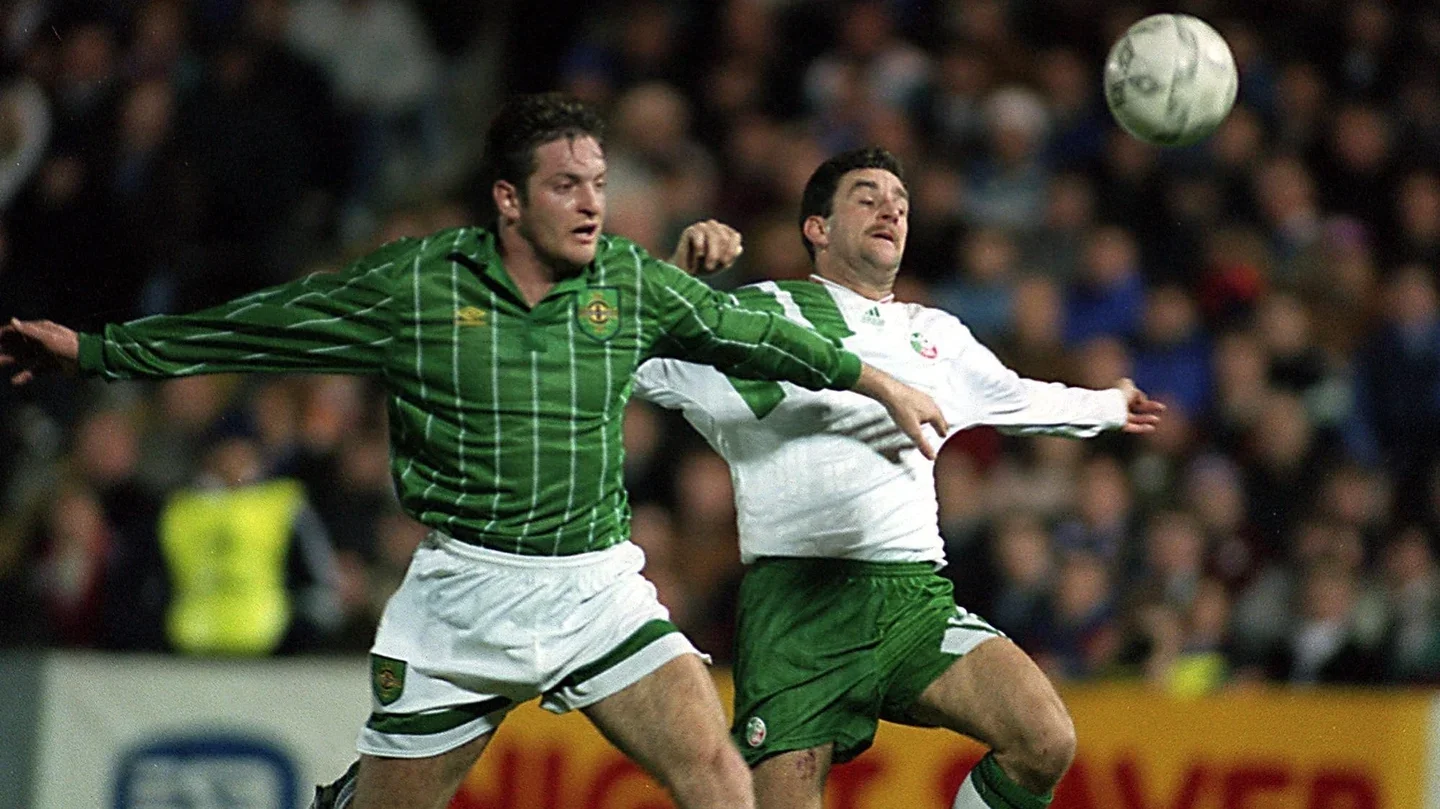
“Clearly there was a different feel to this match”, said former Northern Ireland midfielder Jim Magilton. “That was evident in the city beforehand. It was hostile and I’ve never known such noise, it was constant, lasted the whole match.”
The “doomsday” scenario, as Republic of Ireland manager Jack Charlton had put it, had been confirmed after Spain won 3-1 at Landsdowne Road on October 13th. His side, who were in the middle of the nation’s most successful era to date, were looking to qualify for consecutive World Cups. They had qualified for their first edition of the tournament in 1990; where they surpassed expectations by reaching the quarter-finals.
Northern Ireland, meanwhile, knew that they couldn’t qualify. Their manager, Billy Bingham, had overseen two World Cups qualifications in the 1980’s - defeating hosts Spain to qualify for the second round of the 1982 tournament. Bingham, who had managed the team for 17 years over two spells, was to retire after the 1994 World Cup qualification campaign. The reverse fixture had gone ahead without an issue in March. The Republic beating Northern Ireland 3-0 - thanks to goals from Andy Townsend, Niall Quinn and Steve Staunton in 10 first-half minutes.
However, Bingham had taken offence to the chants of ‘there’s only one team in Ireland’ by the home fans and believed that Charlton had “rubbished” his players. Magilton, who played in both games for Northern Ireland, didn’t concern himself too much with those complaints.
“I regarded it more as banter and because the home side were so on top. I was more focused on them as a team – the Republic had some top-class players and they were so much better than us on the day. We weren’t competitive and Billy took it personally. I’ve never seen him as animated, he was always very calm before and after games.”
Bingham stokes the flames before the game in Belfast, when he labelled the Republic of Ireland’s players as “mercenaries”, due to the fact that many had not been born in the country and had qualified for selection through family.
“I take a totally cynical view of the whole business. I am not prepared to skirt the issue, the same as I am happy to state it is our intention to stuff the Republic,” he declared. He would later withdraw his remarks.
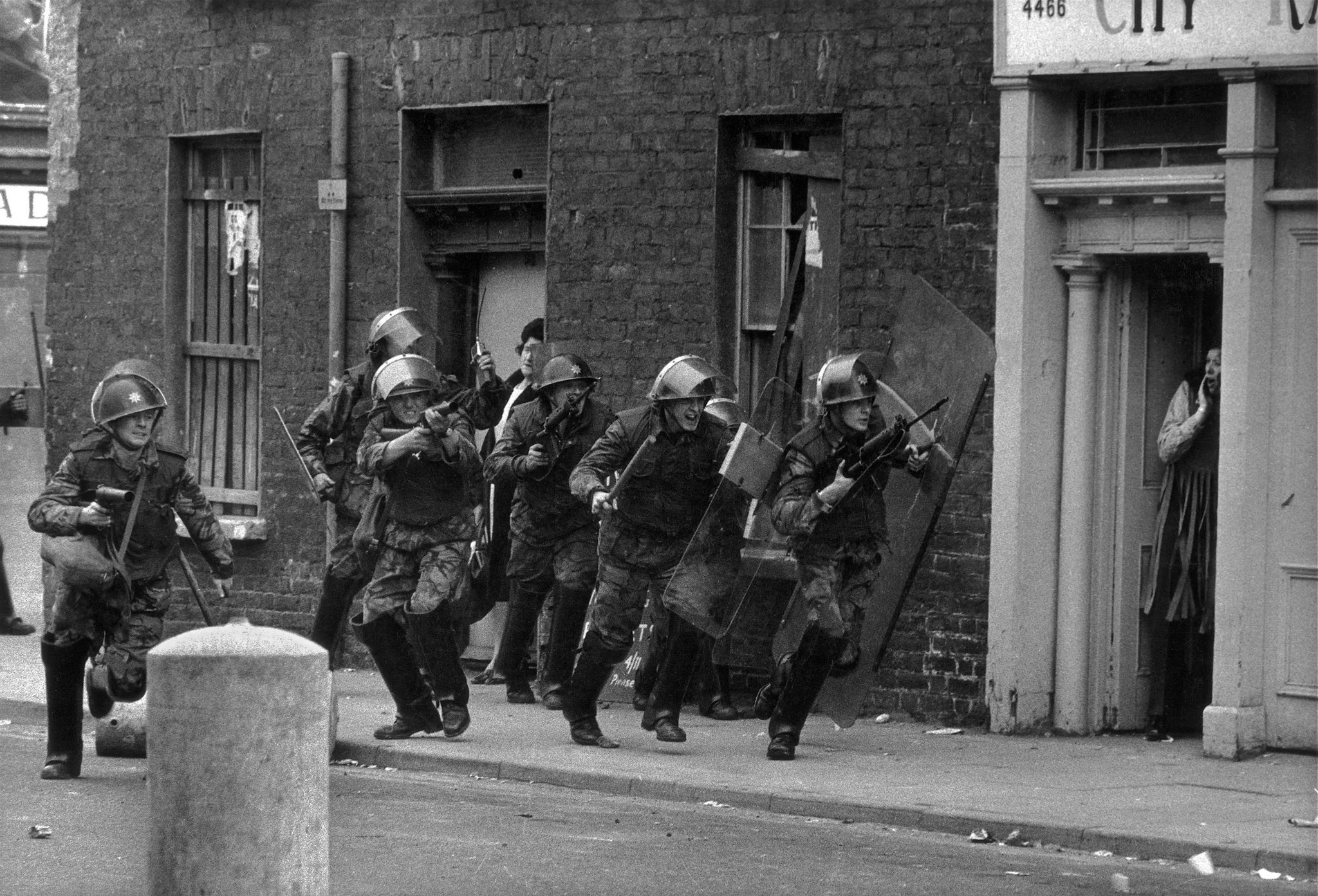
Ultimately, the tension was already there heading into the return fixture in Belfast, where far more concerning things were happening. Two days after the Republic of Ireland’s game against Spain, Paddy McMahon, a 23-year-old Catholic, was shot dead in north Belfast by the UDA (Ulster Defence Association). It was the first of 26 deaths in 18 days in the north’s Troubles including the IRA (Irish Republican Army) bomb at Frizzell’s fish shop on the Shankill Road and the UDA (Ulster Defence Association) ‘trick or treat’ massacre at the Rising Sun pub at Greysteel.
There was a two-week respite without killing before the match at Windsor Park. However, tensions were incredibly high and the atmosphere in Belfast as grim as it had been during the peak of the Troubles in the 1970’s. With the violence escalating to horrifying levels and communities across the north suffering devastating grief, the FAI (Football Association of Ireland) sought assurances over the safety of its players before travelling across the border.
They voiced their concerns to world governing body, FIFA, who informed FAI general secretary Seán Connolly, that a change of venue was ‘imminent’, a fortnight before the game. The IFA (Irish Football Association), who governed football in Northern Ireland, did not wish to return to the days when security issues had left them unable to stage games at Windsor Park from late 1971 to 1975. They managed to persuade FIFA to backtrack, having assured them that the game was safe to take place in Belfast. FIFA then stated that the match had to go ahead at 8pm – not noon as had been suggested – to coincide with Spain-Denmark
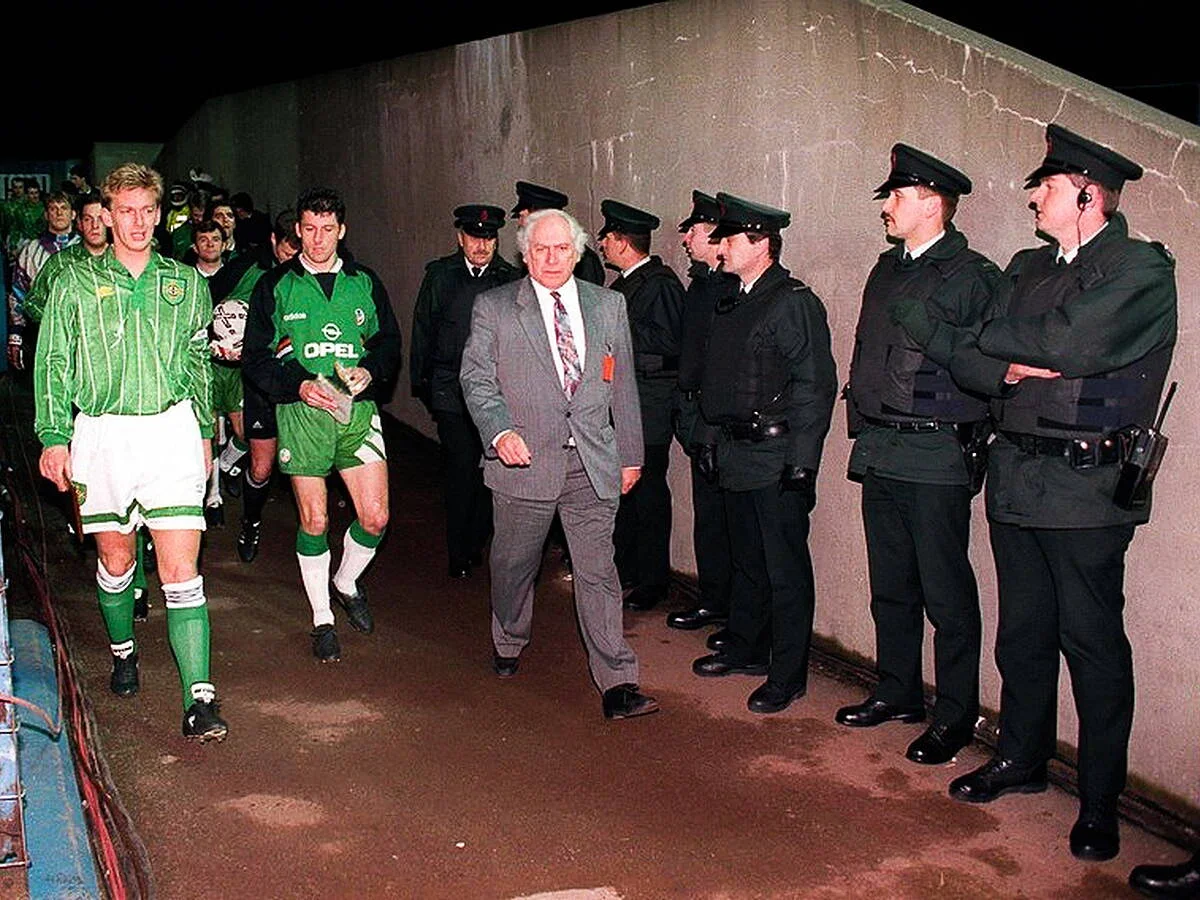
There was to be no away support and no Amhrán na bhFiann (the national anthem of the Republic of Ireland). The assignment for Jack Charlton’s side was to be far from simple. The Republic squad were advised to fly to Belfast from Dublin, rather than crossing the border by road from their base in Monaghan. Having arrived the day before, they spent the day of the game training and resting. Then, the time came to make their way to the ground and into the lion’s den. The bus drove slowly through the streets of Belfast, lights turned off and players sitting on the aisle seats rather than close to the windows for security reasons. It was deathly quiet with a police presence on board and an escort both in front and behind the vehicle.
“On the bus to the game, I remember seeing a group of young kids with sticks pretending they were rifles and they were pointing them at us,” Republic striker Niall Quinn said. “They’d shoot, kneel down and another row would shoot. I thought: ‘Jesus, this is crazy stuff’”.
However, that was only a small taster of the sectarian hatred on show that evening. On the pitch, the Republic of Ireland players were greeted by a cacophony of sickening abuse and vitriol. Including racial abuse aimed at Paul McGrath and Terry Phelan. Then there was the torrent of abuse aimed at ‘turncoat’ Alan Kernaghan.
Born in Yorkshire, Kernaghan had moved to County Down (Northern Ireland), aged six. His parents were English but his father’s parents were from Northern Ireland. Strangely, he represented Northern Ireland at youth level but could not earn a senior cap due to the IFA’s aversion to selecting players based on their grandparents’ nationality. He approached the IFA, “but it was just a ‘no’,” as he explained later. “Out of the blue I was approached by the Republic, and professional football is such a short career that I took the opportunity to play international football. Let’s face it – you want to play for somebody that actually wants you.
“It was a strange situation to be in. I tried for so long to get playing for Northern Ireland but it never came off. Then all of a sudden I was playing for the Republic of Ireland.”
His reasoning didn’t pass much muster with sections of the Windsor Park crowd, who directed a torrent of vile insults his way. Speaking in the book ‘Stuttgart to Saipan - The Players' Stories’, Kernaghan recalled: “You could feel the venom in it. 'Pope-sucking wh*re', 'your mother's the Pope's wh*re'. That sort of stuff. You just get on with it. Try and immerse yourself in the game. Sometimes it's as if the whole crowd goes dead bar that one person and you can see them and hear exactly what they're saying. It's difficult not to have a reaction to it."
The so-called ‘granny’ rule had been a hot topic in the buildup to the game. Only four of Charlton’s starting XI were born in Ireland; 10 of Bingham’s were local. Bingham didn’t retract his ‘mercenaries’ comment before the game and would whip the Windsor Park crowd up further into a frenzy before kickoff, with impassioned gestures towards the home support.
With the thunderous noise of the crowd ringing in the players’ ears, amidst almost unbearable tension, the match finally kicked off. In truth, the game was a mundane affair with few chances in the first 70 minutes of play. The howling wind and high stakes of the occasion doing little to help produce high-quality football.
The uninspiring nature of the match, though, did little to temper the sectarian hatred in the crowd. Fans taunted their southern visitors with chants of “trick of treat”. A sickening reminder of the final words victims of the Greysteel massacre heard on Halloween night in 1993, when members of a loyalist paramilitary force opened gunfire at a pub - killing eight people and wounding 19 others.
Then, Northern Ireland’s Jimmy Quinn scored a spectacular flying volley from 20 yards to send the home fans into delirium.As Quinn, of a Catholic background, ran off celebrating, Bingham’s assistant manager Jimmy Nicholl shouted “up yours”, or words to that effect, at Charlton’s dugout. Three minutes earlier, Republic of Ireland midfielder Alan McLoughlin had replaced Ray Houghton.
He was now cursing his luck. He knew the goal - which had given the opposition an enormous lift - would make finding his feet in the match significantly harder. McLoughlin, a Mancunian from Maine Road, went to school with Noel Gallagher from the band Oasis and joined Manchester United as a teenager. His parents, Nora and Pat, came from Limerick and Galway. After being released from United in 1986, he rebuilt his career at Swindon Town. It was there, that he caught the eye of the English and Irish international setups.
One day, he opened a letter from the English FA saying he had been called up to play a ‘B’ international in Cork against the Republic of Ireland. He opened the next letter which said that he had been called up by the FAI to play in the same game.
“There, on top of a pile of mail, was a pristine envelope with the three lions crest on it," McLoughlin said in his autobiography, 'A Different Shade of Green'. “My heart started racing. I had been selected to play for England ‘B'. I excitedly started making telephone calls. I couldn't get through to Dad at his work, so next I called Mum. She was delighted with the news.
“Then I turned back to the pile of mail sitting on the door mat. Four other letters – fast food menu, council tax bill, energy bill – and one plain, slightly dog-eared brown envelope. It was from the Football Association of Ireland. I had been selected to play for Ireland ‘B' too!
“I phoned Mum up again. This time, I heard a little crack of emotion in her voice as she told me how proud of me she was. Although she was trying to hide it, she was a lot more excited. This was the woman who had regularly cycled across Manchester in the rain just to watch me play school matches as a kid. And that was it for me: Ireland."
In March 1990, the Ireland Bs took on the England Bs at Turners Cross Stadium in Cork. McLoughlin, representing Ireland, scored a goal in a 4-1 win for the Irish. Having made his choice, he went on to be named in Jack Charlton’s World Cup squad later that year, making substitute appearances against England and Egypt.
Now, nearly three and a half years later, he was making his 15th international cap at Windsor Park. With the Republic of Ireland’s dreams of USA ‘94 threatening to implode, they won a free-kick deep inside the Northern Ireland half. Dennis Irwin’s cross was cleared by Gerry Taggart, whose header found McLaughlin standing just outside the penalty area. Showing great technique, the Portsmouth man chested the ball down before unleashing a dipping volley into the bottom corner. The goal, scored just three minutes after Quinn’s opener, was met by complete silence from the home crowd. It was as if a pin had burst all the energy and noise out of the stadium. The only celebrations came from those in white Republic of Ireland jersey’s, who half-grasped each other in celebration.
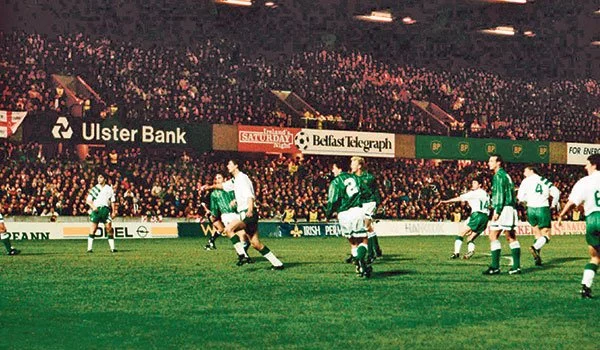
In response, the Northern Ireland fans let out a defiant chant of “there’s only one team in Ireland.” As the final whistle blew, the Republics’ players had to endure an unbearable wait as it became apparent that a Denmark equaliser in Spain would change everything. However, it didn’t come. By way of more goals scored than the Danes, the Republic of Ireland were going to USA ‘94.
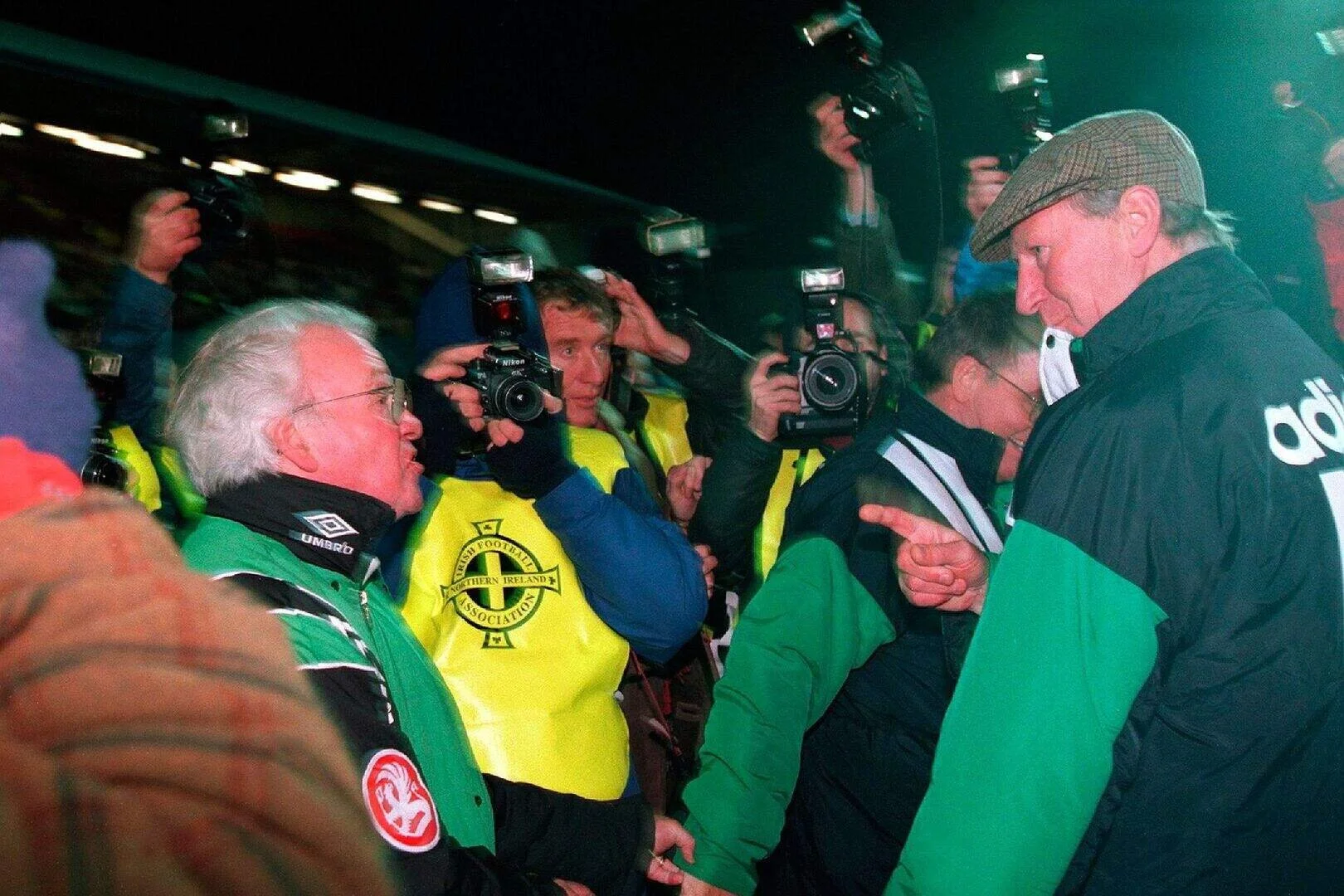
Amid the chaos, Jack Charlton went over to his counterpart, Billy Bingham, to shake hands and wish him well on his retirement.
“At least, that was my intention,” Charlton said in his autobiography. “Instead, in a moment I still find difficult to understand, I pointed a finger at him and blurted out: ‘Up yours, too, Billy.’”
The exchange was captured by photographers to create an iconic image of a moment Charlton regretted immediately:
“I’m afraid it was that kind of night, we were all swallowed up by the tension.”
A short while later, Charlton took it upon himself to apologise during Bingham’s farewell press conference. Bingham accepted and Charlton was amazed to be asked to present the Northern Ireland manager with an award to honour his contribution to Irish football.
“Some of the people who had been abusing me all evening are stood there cheering,” Charlton said. “I think that said it all about a crazy, noisy night.”
While this was happening, Northern Ireland hard man and captain, Alan McDonald, had made his way to the visitors’ dressing room.
“Alan was 100 miles an hour, loud, committed, real, but cute,” Niall Quinn says of the man who marked him that night. “He would come through you, apologise to the ref, do it again. But he came into our dressingroom after and congratulated us. He made a short speech in which he said football had won and it will always win. In the circumstances, the poison in the air…
“So I remember the low – trick or treat. And when I think about the night I can’t separate it from Greysteel and the people in the pub. I can’t. It has stayed with me.
“I was proud to play in the game, I was. I was glad it went on and wasn’t called off or moved to England. Then Alan’s goal, that was the best bit of the night, our fans singing: ‘Who the fuck is Alan?’
“That was the low and the high. But the most important bit, that was Alan McDonald in our changing room.”
The team flew back to a heroes’ welcome at Dublin Airport. Taoiseach (Irish head of government), Albert Reynolds, even made an appearance - highlighting the national importance of the achievement. The match, though, had brought into focus the extent of the divide and feeling in the north. Worse was yet to come. On 18th June 1994, Irish football fans the world over gathered to watch the Republic take on the might of Italy in their first game of the World Cup, played at the magnificent Giants Stadium in New York. The same was true in the family-owned Heights Bar located in the Northern Irish village of Loughinisland, County Down. There must have been a buzz that Saturday night as punters filed in. A pride to see their team represented on the greatest sporting stage of all.
Then, shortly after 10pm - with Ireland 1-0 up and the second half just started - two loyalist gunmen burst in, sprayed the pub with bullets and killed six men. Barney Green was one of those who died. He was 87, described by friends as “really jolly”.